

A child’s autism diagnosis does not have to feel like an unbearable weight for your family to carry. You might be scrolling through your phone after everyone went to sleep wondering if your world has changed forever.
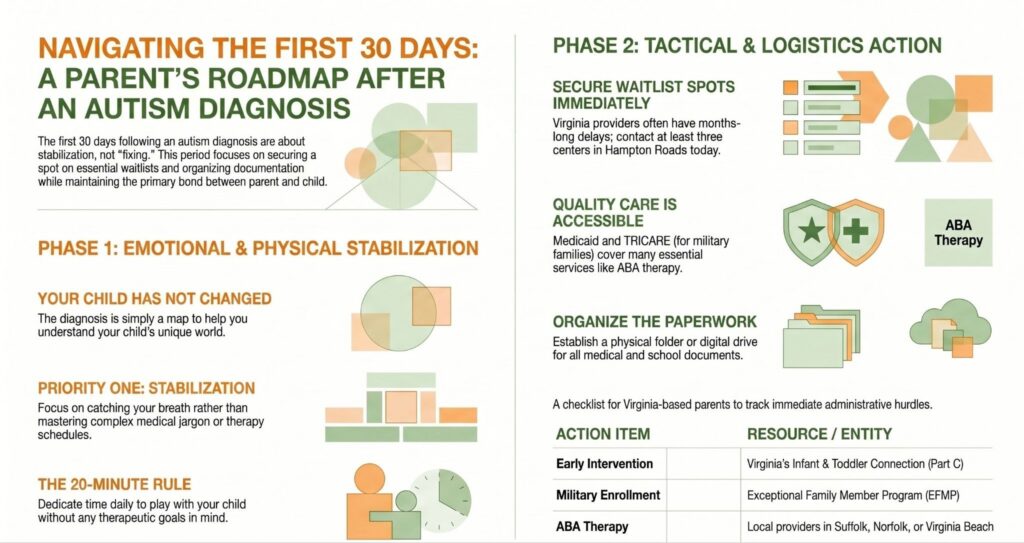
It did, but not in the way you might fear. The first 30 days after an autism diagnosis are not about fixing your child or mastering complex medical jargon. They are about stabilization. Your goal right now is to catch your breath, secure your spot on the necessary waitlists, and remember that your child is the same wonderful person they were ten minutes before the doctor handed you that paperwork.
Within the first 30 days of your child’s autism diagnosis, Norfolk Autism Center in Suffolk, Virginia, can help create a plan to better understand autism and how your family can help treat your child.
The Short Answer: What should I do first?
After an autism diagnosis, your immediate priority is to apply for Virginia’s early intervention services and get on waitlists for Applied Behavior Analysis (ABA) therapy. Because providers in the Hampton Roads area often have months-long delays, securing a spot now buys you time to process your emotions without feeling like you are losing precious days. Focus on one practical step at a time: address your insurance needs, call providers in Suffolk or Norfolk, and then allow yourself to simply be a parent.
Key Takeaways
- Avoid rushing into every therapy at once. It is better to start with one or two programs that fit your child’s personality.
- Waitlists are a major hurdle in Virginia. Contact providers in Suffolk, Norfolk, and Virginia Beach immediately to check availability.
- Quality care is accessible. TRICARE and Medicaid cover many autism services, so you do not need a massive savings account to begin.
- Your child is still the same person. The diagnosis is just a map to help you understand them better, not a new identity.
A Quick Self-Check for Virginia Parents
If you are feeling overwhelmed, ask yourself these five questions as you decide what to do after an autism diagnosis. There are no wrong answers, just a way to see where you are today.
- Do I have a physical folder or digital drive to keep all the medical and school paperwork in one place? (Yes/No)
- Have I called at least three ABA providers to check their current waitlist times? (Yes/No)
- Have I reached out to one friend or family member who can just listen without giving advice? (Yes/No)
- Am I allowing myself to feel sad or frustrated without judging those feelings? (Yes/No)
- Have I spent at least 20 minutes today just playing with my child, with no therapeutic goals in mind? (Yes/No)
Autism Diagnosis Next Steps
We know a child diagnosed with autism is overwhelming. We have been in those shoes. The “First 30 Days” after your child’s autism diagnosis isn’t a race to see how much therapy you can cram into a week. Instead, it is a period of transition where you move from a space of wondering to a space of knowing. Your child has not changed, but your understanding of their needs has.
Many parents in our Suffolk community tell us they felt like they had to become an overnight expert on neurology, insurance codes, and educational law. You do not have to do that. Right now, your job is to be a mom. Let the specialists handle the clinical details while you focus on being the person your child feels safest with.
What the First 30 Days Are Actually About
Most advice tells you to act now because early intervention is everything. While early intervention does matter, it doesn’t mean you need a full schedule of forty hours a week of therapy by next Tuesday. If you are stuck in a developmental plateau where your child isn’t hitting milestones, the pressure to act can feel crushing. However, the first month is really about gathering information and finding your footing.
It is about learning how your child sees the world. Autism is not a broken version of normal, it is a different way of processing surroundings. You are learning a new language. Just like learning any language, it takes time and patience. You do not need to be fluent in thirty days.
If you spend the first two weeks just processing the news and doing nothing else, you haven’t failed. Taking that time to settle your own heart makes you a more effective advocate for your child later. You are building a foundation for a long journey. You don’t build a house in a day, and you don’t build a support system in a week.
The Steps That Actually Move the Needle
When you are ready to move from processing to action, follow these four steps. This helps you avoid the analysis paralysis that comes from having too many options.
- Request a Developmental Evaluation. If your initial diagnosis didn’t include a full developmental profile, ask your pediatrician for a referral to a specialist who can detail your child’s specific strengths and needs.
- Get on Waitlists Early. Contact ABA centers in the Hampton Roads area today, even if you aren’t certain which one you will choose, because waitlists can be very long.
- Ask About Early Intervention Services. Reach out to your local school district or Virginia’s Part C providers to see what state-funded support is available for children under age six.
- Learn the Basics of ABA. Look for Natural Environmental Training (NET), which focuses on learning through play rather than sitting at a desk for hours doing drills.
At Norfolk Autism Center, we believe therapy should be joyful. We use a Montessori-inspired approach because children learn best when they are curious and exploring. If a clinic feels like a hospital, it might not be the right place for a four-year-old. Look for a space that feels like a preschool, warm, inviting, and full of toys.
If you’re in the Hampton Roads area and want to talk through next steps, we’re here. Call Norfolk Autism Center at 757-786-3588 or fill out our form on our contact us page to learn more, verify insurance and ask questions.
What to Do If You’re a Military Family
Living in a military hub like Hampton Roads adds a layer of complexity to an autism diagnosis. If your spouse is currently deployed or you are preparing for a PCS (Permanent Change of Station) move to Naval Station Norfolk or Joint Base Langley-Eustis, the stress can feel unmanageable. You might be solo-parenting and navigating this entire system on your own.
First, know that TRICARE Comprehensive Autism Care Demonstration (ACD) covers ABA services for the children of active-duty service members. You will need to enroll your child in the Exceptional Family Member Program (EFMP). This isn’t just a hurdle, it is a protection. It ensures that when the military moves you, your child’s needs are considered in your next duty station.
Solo parenting during a deployment while navigating a new diagnosis is an incredible burden. You are doing the work of two people with half the sleep.
Early Intervention Autism in Virginia
Suffolk and the surrounding cities, including Virginia Beach, Chesapeake, Newport News, and Portsmouth, have many options, but they aren’t all the same. When you start touring facilities, look past the shiny equipment. You want to see how the staff interacts with the children.
Ask the BCBAs (Board Certified Behavior Analysts) how they handle problem behaviors. If their only answer is compliance, keep looking. You want a team that asks why a behavior is happening. Is the child hungry? Overwhelmed by the bright lights? Frustrated because they can’t say what they want?
A Montessori-inspired approach focuses on the environment. We believe if we create a space that meets a child’s sensory needs and follows their natural curiosity, learning happens automatically. Our Suffolk center is designed for children ages 2 to 6 because those early years are when we can make the most impact on communication and social connection. We want our kids to explore, play, and grow in a space that feels like home.
You Don’t Have to Figure This Out Alone
You might feel like you’re standing on the edge of a vast, dark forest. But there are paths through it, and many of us have walked them before you. You aren’t hiring a clinic, you are joining a community. We understand the fear and the grief that can come with a diagnosis, and we are here to guide you toward what is possible.
Take it one day at a time. Today, maybe you just found that folder for the paperwork. Tomorrow, maybe you make one phone call. The day after that, maybe you just take your child to the park and watch them swing. Hope is not vague, it is found in specific gains like a new word, a social connection, or a bit more independence.
The diagnosis doesn’t change who your child is. It only changes how we support them. We’ve seen children find their voices, make their first friends, and grow into independent, happy kids. That same future is possible for your child, too.
Frequently Asked Questions
What should I do immediately after my child is diagnosed with autism? Take a few days to process the emotional impact before diving into paperwork. Once you are ready, prioritize getting on waitlists for ABA therapy and contacting your local early intervention office to secure your spot in the system.
How soon should I start ABA therapy after an autism diagnosis? While starting early is helpful, there is no expiration date on progress. Aim to begin services within the first few months, but don’t sacrifice your family’s mental health or stability to rush into a program that doesn’t feel right.
What is early intervention and does my child qualify? Early intervention is a system of support services for infants and toddlers with developmental delays. In Virginia, children under age three qualify through the Infant and Toddler Connection, while those ages three to five often receive support through the public school system.
Does TRICARE cover ABA therapy for autism? Yes, TRICARE covers ABA therapy through the Comprehensive Autism Care Demonstration for children of active-duty service members. You must be enrolled in the Exceptional Family Member Program (EFMP) and have a referral from your primary care manager or specialist.
What’s the difference between ABA therapy and other autism treatments? ABA therapy focuses on the science of learning and behavior to improve specific skills like communication and social interaction. Unlike some therapies that focus only on speech or physical movement, ABA is a holistic approach that can be adapted to every part of a child’s day.
How do I find an autism therapist or ABA provider near me? Start by asking your pediatrician for a list of local providers or check your insurance company’s online provider tool. In the Hampton Roads area, search for centers in Suffolk or Norfolk that offer play-based, natural environment training.
What if we’re a military family moving to a new area, how do we avoid gaps in care? Contact the EFMP office at your new duty station as soon as you receive orders. Reach out to providers in your new city immediately to get on their waitlists, as TRICARE authorizations can take time to transfer between regions.
What does ABA therapy actually look like for a 2- to 6-year-old? For young children, ABA should look like play. Instead of sitting at a desk, the child might practice sharing while playing with blocks or learn new words while blowing bubbles with a therapist in a natural, comfortable setting.
If you’re looking for a warm, child-led environment in Suffolk, we’d love to have a conversation. It’s not a commitment, just a chance to talk through your options and see if our village is the right fit for yours.
How to Start Your Child’s Autism Care Near Norfolk
Call our admissions team at 757-786-3588. The staff can answer questions about treatment, insurance and what comes next.
Norfolk Autism Center is located 152 Burnetts Way, Suffolk, Virginia.
Helpful Links
- TRICARE Comprehensive Autism Care Demonstration (ACD)
- Autism Speaks: What is Autism
- National Library of Medicine: ABA Therapy
- Kennedy Krieger Institute: Science Support For ABA
- Autism Science Foundation: The Facts Behind Analysis
- SAMHSA National Helpline: 1-800-662-HELP (4357)
- National Suicide Prevention Lifeline: 988
- Crisis Text Line: Text HOME to 741741