

It is 10 p.m., the house is finally quiet, and you find yourself staring at your phone, scrolling through forums and articles. You are looking for an answer to the question that has been nagging you for weeks: Is this working?
You did the research. You fought for the diagnosis. You navigated the maze of insurance authorizations in Virginia. Now that your child has been in Applied Behavior Analysis (ABA) therapy for a few months, you might expect to see dramatic changes. Instead, you feel unsure. Maybe the changes are subtle, or maybe you feel like you are waiting for a breakthrough that hasn’t happened yet.
This feeling is normal. At Norfolk Autism Center, we talk to parents every day who are in this exact spot. You are not imagining the uncertainty, and you are not wrong to ask questions. Progress in autism therapy is rarely a straight line, and it often looks different than parents expect.
This guide helps you identify the real signs of growth and determine if your child’s current program is the right fit.
What Does Progress Actually Look Like in ABA?
When you first start ABA therapy, clinical teams often discuss goals in technical terms. They might talk about “trials,” “mastery criteria,” or “percentages.” While data is essential for your Board-Certified Behavior Analyst (BCBA), it does not always translate to what you see at the dinner table.
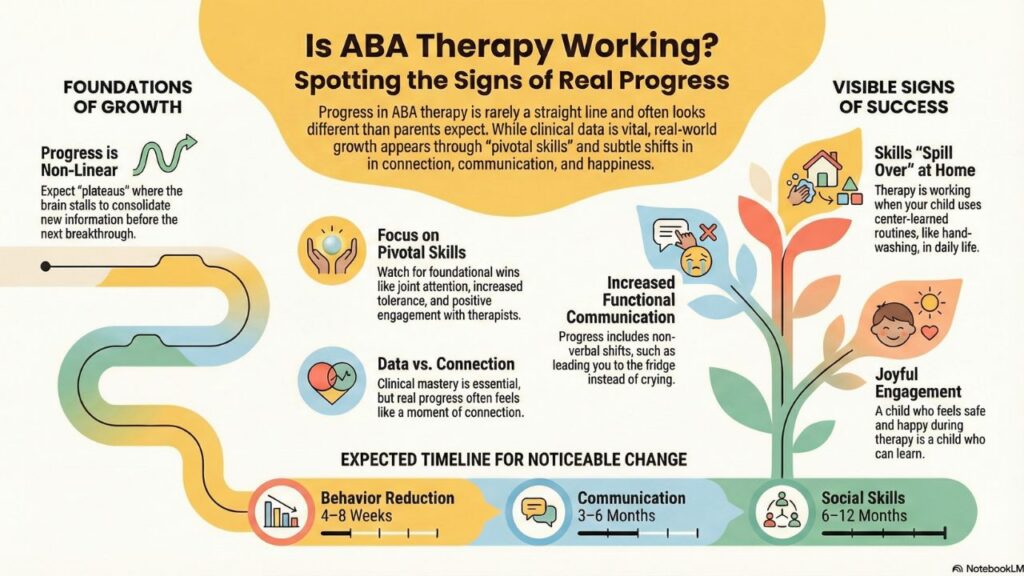
Real progress often feels less like a data point and more like a moment of connection. It is the first time your daughter brings you a toy to show you, not just to have you open it. It is your son tolerating the sound of the vacuum cleaner without covering his ears for the first time.
The Small Wins That Matter Most
In the early months of therapy, specifically the 3-to-6-month mark, big milestones like full sentences or potty training might still be on the horizon. The precursors to those milestones, however, are happening now.
Look for “pivotal skills.” These are foundational behaviors that open the door for further learning.
- Joint Attention: Is your child following your gaze when you point at a bird outside?
- Tolerance: Is your child able to wait just five seconds longer for a snack without a meltdown?
- Engagement: Is your child happy to see their therapist when they arrive at our center?
These small wins are the building blocks of larger success. They indicate that your child is learning how to learn.
Why Progress Isn’t Always Linear
Human development is messy. This is true for neurotypical children and children on the spectrum. You will likely experience weeks where your child seems to learn a new word every day, followed by a month where they seem to stall or even regress.
This “plateau” is often a sign that the brain is consolidating new information. For example, if your child is focusing intensely on learning to walk or jump, their verbal skills might temporarily plateau. In ABA therapy, we expect these fluctuations. We do not panic, but we do pay attention. If a plateau lasts too long, a quality clinical team will adjust the plan.
7 Signs Your Child is Making Real Progress
If you are wondering is ABA therapy working, look beyond the major milestones. Here are seven concrete indicators that your child is moving in the right direction.
Sign 1: New Skills Are Generalizing to Home
This is the gold standard of effective therapy. If your child can identify the color red in the therapy room but cannot find their red shoes at home, the skill is not fully mastered.
You know therapy is working when you see skills “spill over” into your daily life.
- They use the hand-washing routine they learned at the center before dinner at home.
- They use a coping strategy, like taking a deep breath, when they get frustrated with a sibling.
Sign 2: Communication Is Increasing (Even Without Words)
Many parents equate communication with speech, but communication is much broader. Before a child speaks, they must understand that their actions influence the world.
Progress looks like:
- Leading you by the hand to the refrigerator instead of crying in the kitchen.
- Using a picture exchange system (PECS) or a tablet to request a specific song.
- Making eye contact to “check in” with you during play.
These nonverbal shifts are critical proof that your child is understanding the power of communication.
Sign 3: Challenging Behaviors Are Decreasing
Reduction in tantrums is often a top priority for parents. But progress here can be tricky to spot because behaviors often change form before they disappear entirely.
A 20-minute meltdown becoming a 5-minute outburst is progress. Physical aggression turning into verbal protesting is also progress. Your child is forming emotional regulation skills, even if they are not perfect yet.
Sign 4: Your Child Is More Independent
Helplessness is often a learned behavior. Effective ABA therapy empowers children to do things for themselves. You might notice your child trying to pull up their own pants, attempting to open a snack wrapper, or putting their toys away without a hand-over-hand prompt.
When a child initiates a task they used to wait for you to do, it shows their confidence is growing.
Sign 5: Social Connection Is Growing
Autism does not mean a child prefers isolation; it often means they lack the tools to connect. As therapy takes hold, you should see your child’s world expand.
- Parallel Play: Sitting near other children without distress.
- Sharing: Briefly giving a toy to another person.
- Imitation: Copying a funny face or a clap during a song.
Sign 6: Play Skills Are Emerging or Expanding
For a toddler or preschooler, play is their job. If your child previously only spun the wheels of a car, progress looks like driving the car along a track or making “vroom” noises.
Expanding interests is a key sign of success. If your child is willing to try a new puzzle or touch a texture they previously avoided, it shows their rigid boundaries are softening.
Sign 7: Your Child Seems Happier During Therapy
This is perhaps the most important sign of all. Modern, compassionate ABA therapy should be a positive experience.
If your child is generally happy to go to the center or greets their Registered Behavior Technician (RBT) with a smile, it means the environment feels safe to them. A child who feels safe is a child who can learn. If your child is consistently terrified or miserable regarding therapy after the initial adjustment period, that is a significant red flag.
Unsure if your current program is the right fit?
You deserve clarity, not confusion. If you are questioning whether your child is making the progress they should be, we can help. Our Board-Certified Behavior Analysts (BCBAs) offer consultations to review your goals and answer your questions.
No pressure, just partnership. Contact us today to discuss your child’s needs.
When Progress Feels Slow: What’s Normal vs. What’s a Red Flag
You might read the list above and think, “We aren’t there yet.” That does not necessarily mean therapy is failing.
Realistic Timelines for Different Goals
- Behavior Reduction: You may see changes in 4-8 weeks as the team identifies triggers.
- Communication: Gaining a new functional communication method (like pointing or using a device) can take 3-6 months of consistent practice.
- Social Skills: These are complex and often take 6-12 months to develop noticeably.
Questions to Ask Your BCBA
If you feel stuck, schedule a meeting with your clinical supervisor. Ask them:
- “Can you show me the data on this specific goal?”
- “We are not seeing this skill at home. How can we work on generalization?”
- “Is there a barrier to learning we need to address, such as sensory overload?”
A quality provider will welcome these questions and have data to back up their answers. If they are defensive or cannot show you the graphs, it might be time to look for other options in the Norfolk area.
Finding Quality ABA Therapy in Hampton Roads
Your peace of mind matters. You are the expert on your child, and your intuition is a powerful tool. If the progress feels too slow, or if the therapy style feels too rigid, trust your gut.
At Norfolk Autism Center, we believe therapy should be joyful and effective. We utilize a Montessori-inspired, play-based approach that respects your child’s personality while driving real developmental results. We understand the unique needs of families in Norfolk, Suffolk, and Virginia Beach.
Whether you are looking for a second opinion or ready to start a new chapter, let’s talk about what progress could look like for your child.
We proudly accept TRICARE and Virginia Medicaid.
Crisis and Emergency Guidance
- Medical Emergency: If your child is in immediate danger, call 911.
- Mental Health Crisis: Dial 988 to reach the Suicide & Crisis Lifeline.
- Local Support: Contact the Norfolk Community Services Board for local crisis intervention resources.