

It is 11 p.m. The house is finally quiet, but your mind keeps racing. You’ve been scrolling through forums and watching videos of other 2-year-olds, comparing their “mama” and “dada” to your child’s silence. You want to know if a two-year-old not talking is a temporary hurdle or a sign of autism. You aren’t looking for a clinical lecture; you’re looking for a path forward.
While a speech delay is one of the most common early signs of autism, it does not automatically mean your child is autistic. Many children experience “late talking” due to simple expressive delays, while for others, the lack of speech is part of a broader pattern of developmental differences.
The most effective way to tell the difference is to look at how your child communicates without using words, such as through eye contact, pointing, and shared play.
Through evidence-based practices and therapies, Norfolk Autism Center can help you better understand why your toddler may not be talking.
Key Takeaways
- Speech isn’t the only marker. Look for “social communication” like pointing at a plane in the sky or meeting your eyes when they’re happy.
- “Wait and see” isn’t a plan. Trust your gut. If you feel something is off, seeking an evaluation in Suffolk or the surrounding Hampton Roads area is the safest next step.
- Autism is a different way of learning. It isn’t a deficit to “fix,” but a set of needs to support through child-led, play-based therapy.
- Resources are available. Between TRICARE, Medicaid, and Virginia’s Early Intervention programs, help is accessible for military and local families alike.
First, Take a Breath: You’re Asking the Right Questions
If you’re here, you’ve likely had a nagging feeling for a while. Maybe your pediatrician told you to “give it six months,” but that knot in your stomach hasn’t gone away. We want you to know that your intuition is your most valuable tool as a parent. Asking these questions doesn’t mean you’re “looking for problems” or being “overly anxious.” It means you are tuned into your child’s needs.
At Norfolk Autism Center, we talk to families at this exact moment every day. Many are military families in the middle of a PCS to Hampton Roads, trying to find a new support system while a spouse is deployed. Others are local parents who just want their child to be able to tell them what they want for breakfast. You are not alone in this silence, and you aren’t “behind” because you’re looking for answers now.
Signs of Autism in Toddlers Age 2
Developmental milestones aren’t a rigid test your child passes or fails. They are a map of where most children are at a specific age. By age two, most children have hit a “language explosion,” but that looks different for every child.
Speech Milestones: What Most 2-Year-Olds Are Doing
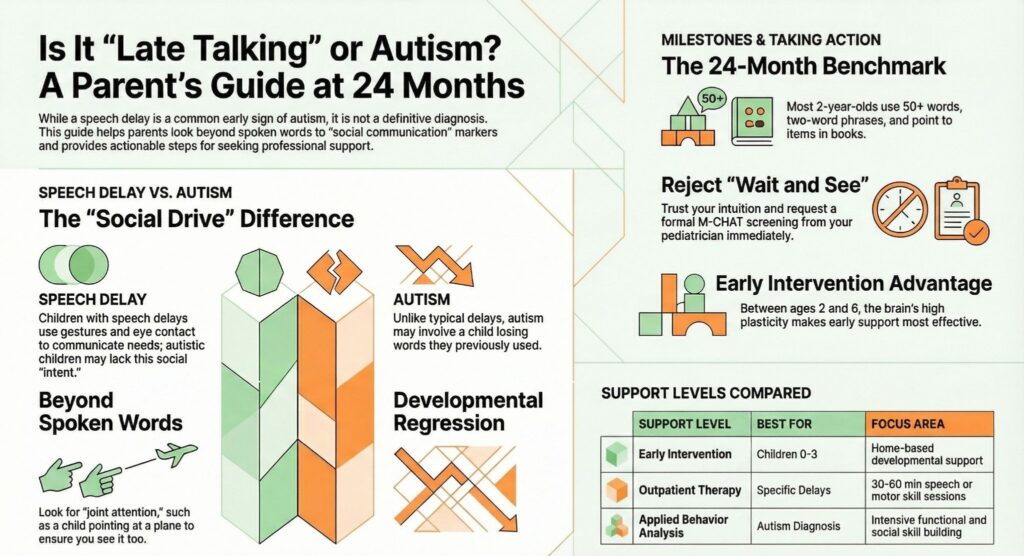
The Centers for Disease Control and Prevention (CDC) and the American Academy of Pediatrics (AAP) suggest that by 24 months, a typical child:
- Uses at least 50 words.
- Puts two words together, like “more milk” or “doggy run.”
- Points to things in a book when you ask “Where is the cat?”
- Points to at least two body parts when asked.
What Counts as a “Word”?
Parents often worry because their child isn’t speaking in clear, adult-like sentences. In the world of early intervention, a “word” is any consistent sound used to represent a specific thing. If your child says “ba” every single time they want their bottle, that counts as a word. Signs (ASL) and consistent approximations count too. We care more about the intent to communicate than the perfect pronunciation of the word.
Speech Delay vs. Autism: What’s the Difference?
This is the question that keeps parents up at night. A “pure” speech delay and autism can look very similar on the surface, but they have different roots.
When a Speech Delay Is “Just” a Speech Delay
In a child with a simple expressive speech delay, the “engine” of communication is working fine; the “tailpipe” is just clogged. These children are usually very frustrated that they can’t talk. They will pull your hand to the fridge, point frantically at the juice, make intense eye contact, and use gestures to make sure you understand them. Their social “drive” is high, even if their word count is low.
When to Worry About a Toddler Not Talking
With autism, the delay often involves more than just spoken words. It’s about social communication as a whole. You might notice:
- Lack of Joint Attention: They don’t point at things just to show them to you, like a bird or a cool truck.
- Limited Eye Contact: They may look at your mouth or hands rather than your eyes, or avoid gaze altogether.
- Repetitive Behaviors: This could be lining up toys instead of “playing” with them, or flapping hands when excited.
- Regression: They used to have five words, but now they don’t use them at all.
- Not Responding to Their Name: It might feel like they have hearing loss, even though you know they can hear the crinkle of a snack bag from across the house.
Quick Self-Check List
If you’re unsure, ask yourself these questions. If you answer “No” to three or more, it’s worth scheduling a professional conversation.
- Does my child look at me when I call their name?
- Does my child point to show me things they think are interesting?
- Does my child bring toys over to me just to show me, not just when they need help?
- Does my child imitate me (clapping, making a silly face, “feeding” a doll)?
- Does my child use a variety of gestures (waving, nodding, reaching up)?
Understanding Your Options: Levels of Support
When you start looking into help, the terminology can feel like alphabet soup. Whether you’re in Suffolk or Virginia Beach, you’ll likely hear about these different levels of care.
| Level of Care | What It Is | Best For |
| Early Intervention (Part C) | State-funded services (Infant & Toddler Connection of VA). Usually provided in your home. | Children 0-3 with any developmental delay. |
| Outpatient Therapy | 30-60 minute sessions once or twice a week (Speech or OT). | Specific, isolated delays like stuttering or fine motor skills. |
| Applied Behavior Analysis (ABA) | Intensive, structured support that focuses on functional communication and social skills. | Children with an autism diagnosis who need more consistent, daily support. |
| Full-Day/PHP Programs | Comprehensive, school-like settings that blend therapy into a daily routine. | Toddlers (ages 2-6) who need a “boost” before starting kindergarten. |
What Should You Actually Do Next?
The “wait and see” approach is the most common advice parents get, and for some, it’s the most frustrating. While some children are truly “late bloomers,” research emphasizes that early intervention is the single most important factor in long-term outcomes.
Start With Your Pediatrician: But Don’t Only Wait
Ask for a formal developmental screening (like the M-CHAT). If the results are “borderline” and the doctor suggests waiting, you still have the right to seek a second opinion or a private evaluation. You don’t need a doctor’s permission to call your local early intervention office in Virginia.
Early Intervention: Why Timing Matters
Between ages 2 and 6, a child’s brain is incredibly “plastic.” It’s wired to soak up language and social cues. Waiting a year to see if they “grow out of it” means missing 365 days of peak learning potential.
What Early Autism Support Looks Like in Hampton Roads
Living in the Norfolk and Suffolk area comes with unique challenges, especially for our military families. Between the stress of deployments and the maze of TRICARE, you need a provider who understands your life isn’t a standard 9-to-5.
In Virginia, the Infant & Toddler Connection is your first stop for state-funded support. But for many families, especially those with an autism diagnosis, a more intensive, play-based approach is needed.
What to Look for in a Provider
Don’t settle for a clinic that feels like a doctor’s office. Your child is two; they should be playing. Look for:
- Montessori-Inspired Environments: Avoid centers where kids sit at desks for long periods. Children learn by moving, touching, and exploring.
- Child-Led Philosophy: Therapy should follow your child’s interests. If they love dinosaurs, the “lesson” should involve dinosaurs.
- Military Fluency: Do they understand the EFMP (Exceptional Family Member Program)? Do they accept TRICARE? Can they help you transition your care if you get orders to PCS?
- Family Partnership: You are the expert on your child. A good provider treats you as a partner, not just a spectator.
At Norfolk Autism Center in Suffolk, we built our space to be the opposite of a cold clinic. We serve families from Chesapeake, Portsmouth, and Newport News who want their children to feel at home while they learn. We prioritize “natural environmental training,” which is just a way of saying we teach kids how to communicate while they’re doing what they do best: playing.
FAQ
Can a 2-year-old have autism if they do say some words?
Yes. Autism isn’t just about the presence or absence of words; it’s about how those words are used socially. Some children may have a large vocabulary but use it to label objects rather than to ask for help or share an experience.
What’s the difference between a speech delay and autism in toddlers?
A speech delay is specifically about language production. Autism is a broader developmental difference that affects social interaction, sensory processing, and behavior, often including a speech delay.
My pediatrician said to ‘wait and see’ — should I get a second opinion?
If your gut says something is wrong, yes. You are with your child every day. Your pediatrician sees them for 15 minutes. Trust your observations.
How early can autism be diagnosed in children?
Reliable diagnoses can often be made as early as 18 months. Early signs are often visible even earlier to trained specialists.
Does TRICARE cover autism evaluation and ABA therapy for young children?
Yes. TRICARE has robust coverage for autism-related services through the Autism Care Demo. We work with military families daily to navigate these requirements.
How do I get early intervention services in Virginia?
You can self-refer to the Infant & Toddler Connection of Virginia. They will provide an assessment and determine if your child qualifies for state-funded services like speech or occupational therapy.
If you’re feeling overwhelmed, remember that a diagnosis isn’t a ceiling; it’s a key. It’s the key that unlocks the specific resources and funding your child needs to find their voice. Whether that’s through our Montessori-inspired program in Suffolk or another local resource, the goal is the same: a happy, connected child.
You don’t have to figure this out alone. You’re joining a village of parents and providers who have walked this path before.
Not sure where to start? Talk to a pediatric autism specialist today who can help you figure out the right next step. There is no pressure and no paperwork yet. We’re here to help you navigate the system, whether you’re a lifelong Hampton Roads resident or just arriving at NS Norfolk.
Start Your 2-year-olds Autism Care Now
Call our admissions team at 757-786-3588 to ask any questions about care, therapy and your child’s care.
Norfolk Autism Center is located at 152 Burnetts Way, Suffolk, Virginia.